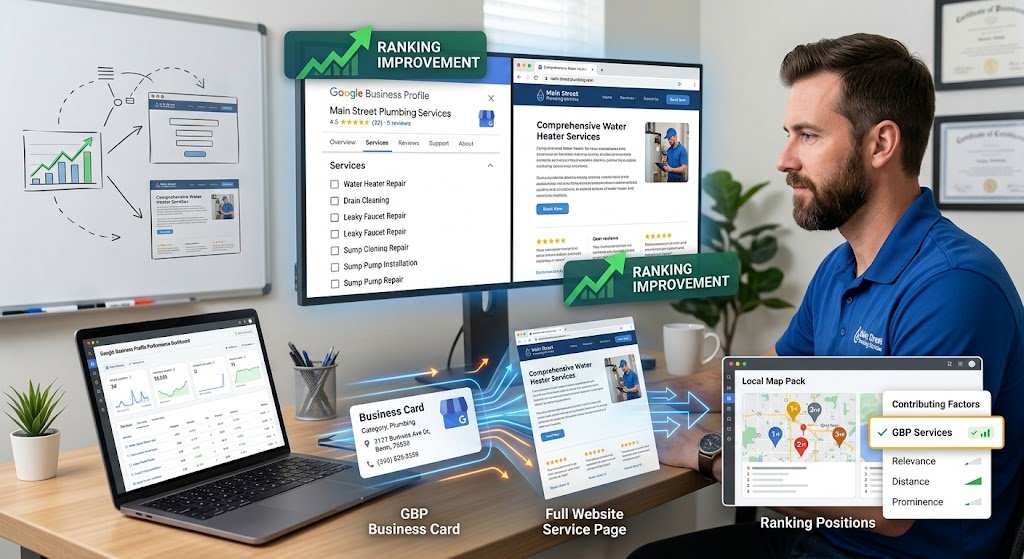
Local SEO testing has flipped the usual advice on GBP services: the services list inside a Google Business Profile does appear to move map pack rankings, according to agency testing that reversed an earlier finding. It still can’t do the work a website with dedicated service pages does.
What this means for you
- Testing by Sterling Sky, echoed by Whitespark, found GBP services can lift rankings; pre-defined services moved more than custom ones.
- Relevance, distance and prominence are still Google’s stated inputs; your services feed relevance.
- Dedicated service pages catch organic searches a bare profile never sees.
- Only a real site can hold the forms, proof, and schema that convert traffic.
- A stalled profile usually needs a structured site behind it, not only more GBP edits.
What the services tab is built to do
Google Business Profile lets owners list individual services, each with a name, a short description, and sometimes a price. It lives inside the free Business Profile dashboard, no website required. Google pulls the list into the profile and can surface it in a services section on mobile.
For a plumber, a salon, or a clinic, it’s often the first thing a searcher sees before deciding to call. It reads more like a menu than a marketing page.
Descriptions are short by design, with no room for photos tied to a specific service, no FAQ, no proof. The tool organizes information inside Google’s interface; it doesn’t build a case for choosing you.
That convenience has a ceiling. Everything sits inside Google’s fixed template — no custom layout, no internal links, no space for the detail that turns a browser into a caller. A structured site behind the profile closes that gap.
Owners treat the services list as either useless or a magic lever. The testing says it is neither.
Where ranking signals actually come from
Google says local results are based primarily on relevance, distance, and prominence, as set out in its own guide to local ranking. Services are not named as a separate factor; what you list feeds relevance.
Relevance is how well a profile matches the search term and category. Distance is how close the business sits to the searcher. Prominence is how well-known the business is across reviews, links, and the wider web.
Primary category still carries more weight than most owners assume. Picking “plumber” over the vaguer “contractor” does more for relevance than anything listed underneath it.
Whitespark’s Local Search Ranking Factors survey asks working local SEOs which signals move results. The current edition, published in November 2025 as the 2026 report, drew on 47 contributors and again places Business Profile signals, review signals, and on-page content among the heaviest groups.
None of the three works in isolation. A business with strong prominence but weak relevance can rank behind a competitor whose profile and site align tightly with the search term.
Where GBP services actually help
The list is not decoration. Sterling Sky, a local SEO agency that publishes its own ranking tests, reported in 2023 that adding Google’s pre-defined services lifted rankings for related keywords — reversing the agency’s own 2019 test, which had found no effect.
A follow-up published in January 2024 found custom services help too, but to a much smaller degree than pre-defined ones. These are single-agency tests on a small number of listings, so treat the size of the effect as directional. Whitespark’s Darren Shaw says his own testing confirmed it, and his 2026 report ranks predefined services as the #22 factor.
Sterling Sky also reported a ranking benefit even when price and description were left out. Pricing details mainly help a customer decide; those tests found no separate ranking weight.
Why a bare profile stalls out
Map pack clicks land on the profile itself. Everything else — the organic links below it, the “people also ask” boxes, long-tail searches like “emergency water heater repair [city]” — routes through organic web results, not the profile.
A profile has one page. A site can have one page per service, each with its own title tag, headings, and content built around a single search.
“A profile can tell Google what you do. It can’t tell a customer why to pick you, and it can’t rank for the dozens of long-tail searches a real service page is built to catch.”
Without those pages, strong profile traffic hits a dead end. Visitors see the listing, click through to an outdated one-page site, and leave without calling.
Long-tail phrases like these are more specific than the head terms a profile ranks for, and a site built to answer them captures demand a listing never touches.
To be clear about what the research covers: Sterling Sky’s study measured ranking, not conversion. What happens after the click depends on the site the click lands on.
A stronger site doesn’t replace the profile. It gives the traffic the profile earns somewhere real to land, with proof, pricing context, and a clear next step.
What a structured site adds
Here’s what to weigh before deciding the profile alone is enough.
| Feature | GBP services tab | Dedicated service page |
|---|---|---|
| Description length | Short, template-limited | Unlimited, built for depth |
| Structured data | Not available | Service and LocalBusiness schema |
| Internal linking | Not possible | Links to related pages and proof |
| Lead capture | Call or website click; chat retired July 2024 | Custom forms, tracked conversions |
| Search visibility | Map pack, Maps, and profile | Organic search, map pack, and paid landing pages |
None of this makes the profile optional. It makes it half of the system — the half that earns the click, not the half that earns the sale.
A dedicated page also carries page speed and mobile layout you control, tuned to the searches Google already surfaces the profile for. Google’s template isn’t built to be a landing page.
It also carries structured data the profile can’t. Service and LocalBusiness schema help Google match a specific page to a specific search.
Building service pages that convert
A dedicated service page earns its keep only when it does more than restate the profile. Each page should carry:
- A single service named in the heading, matching what people actually type into search.
- Local proof: project photos, reviews, or before-and-after specifics for that service.
- A short FAQ block answering questions customers and Google both ask.
- A call-to-action or form placed above the fold, not buried at the bottom.
- Internal links to related services and supporting blog content.
- Schema markup so Google can match the page to the right search intent.
None of this needs to be complicated. A handful of well-built service pages, each answering one question clearly, will usually outperform a single generic “services” page.
Treat these pages as living documents, not one-time launches. A quarter of traffic data usually reveals which pages need sharper headlines or stronger proof.
This is the structure ProXSites builds into its Pro and VIP website packages — service pages built for search, not a profile with a homepage attached.
Search behaviour shifts, so service pages need occasional updates. A site with ongoing updates and analytics can adjust wording or add a page as new searches emerge; a static profile never does.
How the profile and the site work together
None of this is an argument against Google Business Profile. Fill the services list out — the testing points that way — keep the primary category tight, and keep reviews coming.
The profile earns the click. The site converts it, ranks for searches the profile can’t reach, and gives you a place to add proof and adjust messaging.
Start with whichever piece is weaker: a thin profile or a bare site. Filling either gap compounds once both halves are working together.
Treat the two as one funnel, not two projects. A profile with no site wastes the traffic it earns; a site with no profile misses traffic Google would hand it for free.
Businesses that pair both tend to convert more map pack clicks into calls, quotes, and bookings, because there’s somewhere real for that click to land.
See what a structured site could do with the traffic your profile already earns. ProXSites builds and hosts service pages designed to convert, not just exist.
Sources
- Google Business Profile Help — Tips to improve your local ranking (accessed September 2026)
- Google Business Profile Help — Add or edit services (accessed September 2026)
- Google Business Profile Help — Chat and call history removed July 31, 2024 (accessed September 2026)
- Whitespark — Local Search Ranking Factors, 2026 edition (published November 2025)
- Sterling Sky — Do Services in Google Business Profiles Impact Ranking?
- Sterling Sky — Do Custom Google Business Profile Services Impact Ranking? (January 2024)
Disclosure: ProXSites builds and hosts websites for small and local businesses, and the ProXSites links above point to our own paid packages, so we have a commercial interest in this advice.
The ranking findings here come from Sterling Sky’s tests on a small number of listings and from Whitespark’s practitioner survey and testing; we have not replicated either. This is our perspective on local search visibility and conversion, not an audit of Google’s ranking algorithm.