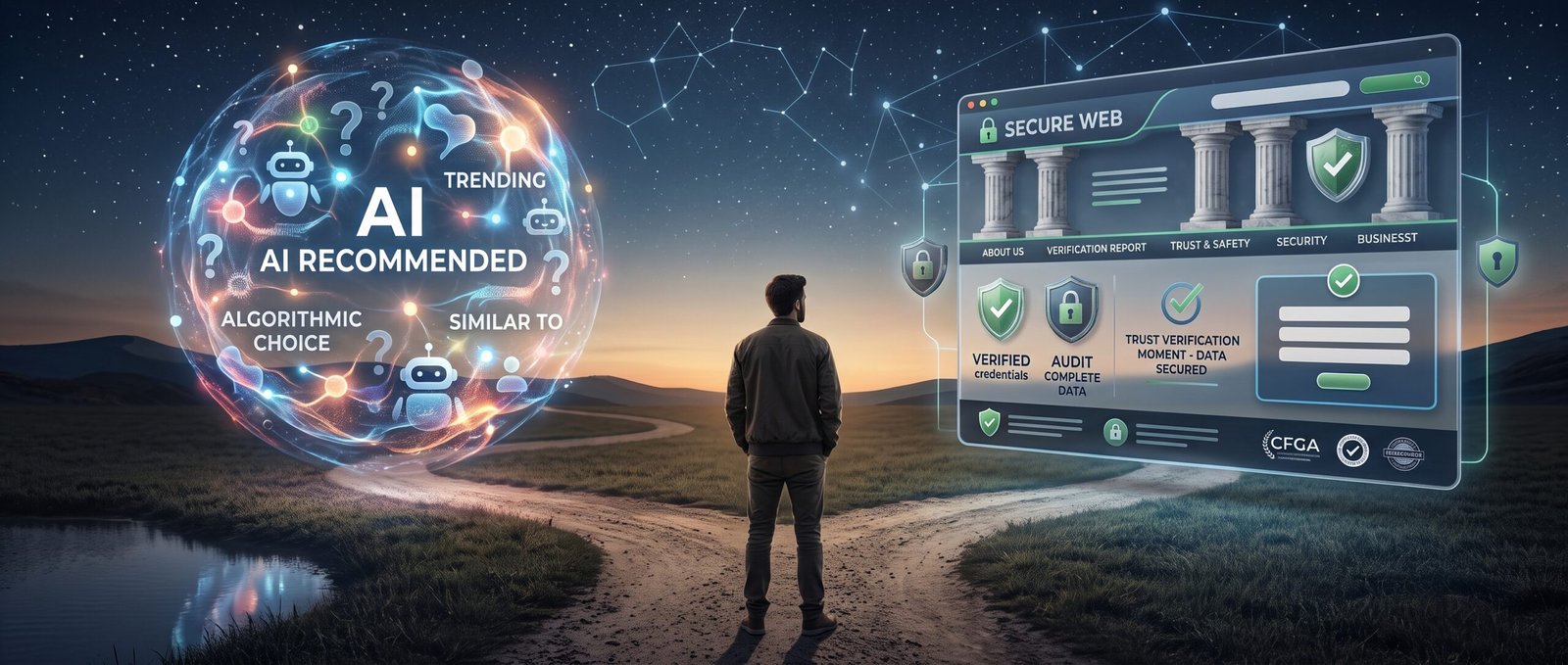
Fifty-eight percent of US consumers say they trust content less the moment they suspect AI wrote it — and that skepticism follows them to your Google Business Profile, where there’s often nothing left to check.
What this means for you
- AI narrows the options, but 44.7% say they usually visit the company’s own site after an AI recommendation.
- A bare Google Business Profile can’t pass that verification test.
- 61.1% link site quality to product quality in buyers’ minds.
- Speed, uptime, and security shape that verification moment.
- Rising skepticism of AI content makes your own website the tiebreaker.
AI is now the front door to your business
Nearly six in ten consumers use AI tools for early research, and 53.8% say they sometimes or often skip company websites entirely at that stage.
Some 61.2% believe AI will eventually replace websites as the primary way people discover products, according to Kinsta’s 2026 report — a Propeller Insights survey of 1,008 US consumers with a ±3-point margin of error.
For a local clinic or a plumber, the first impression is often a summary an AI wrote from a Google Business Profile and a handful of reviews — not the business’s own words.
A bare listing hands that summary all the credibility. A real website gives you a say in it. That’s the gap ProXSites fills for businesses currently running on a profile alone.
AI tools build that summary from whatever’s indexable and current: your category, your review text, maybe a line from a directory. None of it was written to sell you specifically.
An AI overview doesn’t visit your site and decide it’s great. It stitches together public snippets and presents them as settled fact, gaps included.
A business with a thin profile and an outdated site gives that summary less to work with than a competitor with more to show.
Trust in AI is thinner than the traffic suggests
Consumers are using AI heavily, but they don’t trust it much. 58% say they trust content less once they suspect it’s AI-generated, and 52.1% say they trust traditional search more than AI — a narrow lead inside the survey’s ±3-point margin.
Only 18.8% say they always trust an AI product recommendation without doing additional research.
The skepticism runs wider than product recs: 90.7% say they’re concerned about AI-generated misinformation, and 59% have stopped engaging with content they suspected was AI-written.
Fake reviews compound it. 70.9% have suspected a product review was fake or AI-generated, which means a strong star rating doesn’t close the sale by itself anymore.
Here’s where that skepticism concentrates, according to the report:
| Metric | Share of consumers |
|---|---|
| Trust content less once they suspect AI wrote it | 58% |
| Trust traditional search more than AI | 52.1% |
| Concerned about AI-generated misinformation | 90.7% |
| Stopped engaging with suspected AI content | 59% |
| Suspected a product review was fake or AI-generated | 70.9% |
| Always trust AI product recs without further research | 18.8% |
The website is the verification step
This is the moment your website earns the sale or loses it. 44.7% say they visit a company’s website after an AI recommendation always or most of the time.
They’re not browsing. They’re checking.
And what they find sticks: 61.1% associate the quality of a website with the quality of the product or service behind it. A slow, dated template answers a question the business didn’t mean to answer.
What are they checking for, specifically? Service area and hours that match what the AI said, pricing that isn’t a mystery, real photos instead of stock art, and some sign a real person runs the place.
None of that has to be elaborate. It has to exist, load fast, and match the story the AI already told them.
Matt Reid, Kinsta’s chief marketing officer, said when the report published:
“Websites aren’t becoming less important because of AI. If anything they’ve become the crucial last line of defense against bad information.”
A Google Business Profile can’t do this job. It has no room for a case study, a real price range, a portfolio, or an answer to “do you serve my zip code.”
It’s a listing, not a verification surface. Google’s help documentation describes the profile as a place for details like hours, photos, reviews and a map pin — not the deeper proof an AI-referred visitor is now hunting for.
Speed and Core Web Vitals: the first trust test
Once a skeptical visitor arrives, the site itself becomes the test. Google’s Core Web Vitals set three thresholds, measured on real visitors at the 75th percentile: Largest Contentful Paint under 2.5 seconds, Interaction to Next Paint at 200 milliseconds or less, and Cumulative Layout Shift under 0.1.
LCP measures how long the main content takes to appear, INP how quickly the page responds to taps and clicks, and CLS whether the page jumps around while images and fonts load. INP replaced First Input Delay in March 2024.
A page that loads slowly or jumps around reads as neglect to a visitor who already doubts what an AI told them.
Most of that speed comes down to boring infrastructure choices: image compression, a lean theme, and hosting that isn’t queuing your requests behind a thousand other sites.
A small site on solid hosting will often beat a bloated one on cheap shared hosting, because speed is a hosting decision as much as a design one.
Mobile matters most here: Core Web Vitals are scored separately for mobile, usually the harder bar. A layout that wasn’t built mobile-first tends to fail them before it fails on looks.
None of this requires a redesign. It requires someone checking the numbers instead of assuming the site’s fine because it looks fine on a desktop monitor.
Uptime, security, and backups nobody sees until they fail
Uptime and basic security matter for the same reason speed does. A missing SSL padlock or a site that’s down when someone clicks through from an AI summary undoes whatever trust the recommendation built.
Most visitors won’t email you to say the site was down. They’ll just leave and try the next name on the list, AI-generated or not.
Security has a second job now: keeping spam or hacked content off your own pages — the kind of content consumers say they’re already on guard against.
Backups solve a quieter problem. A plugin update that breaks the checkout, a bad edit, a hosting hiccup — recovery time is the difference between an afternoon and a lost week of sales.
For a restaurant or clinic taking bookings online, an hour of downtime means missed calls, abandoned forms, and reservations that went to a competitor.
This is why a static, unmanaged site quietly becomes a liability over time. Nobody’s watching the backups until the day there’s nothing to restore.
Matching the fix to the business
None of this argues for building a bigger site than the business needs. It argues for building the right one, sized to how much proof a buyer needs before they call.
A single-location service business might only need a handful of solid pages, a working contact form, and a fast mobile layout to pass the verification test.
A business with a longer sales cycle — a clinic, a contractor, a firm with several services — usually needs more: a blog that answers real questions, basic SEO, and the legal pages an AI-referred visitor now expects.
Retailers and multi-location brands need the full case: integrated e-commerce, analytics that show what’s converting, and backups that mean a bad day never becomes a bad year.
ProXSites builds all three tiers for exactly this kind of business — the ones with a Google Business Profile already doing some of the work, and nothing solid standing behind it.
Keep the Google Business Profile. It’s still doing real discovery work. Just stop asking it to do a website’s job.
The two are supposed to work together — the profile gets found, the site gets believed.
Your Google Business Profile got someone to consider you. Your website decides whether they trust you enough to call.
Sources
- Kinsta, “Websites aren’t dead: Consumers still rely on them over AI” (September 22, 2026); survey of 1,008 US consumers by Propeller Insights, ±3 points
- Google web.dev, “Web Vitals” (updated 2024)
- Google Business Profile Help (accessed September 2026)
Disclosure: ProXSites designs, builds, and hosts websites for small and local businesses, so it has a commercial interest in the argument made here. The survey data is Kinsta’s; Kinsta is a managed WordPress hosting provider with a similar interest, commissioned the poll, and had no involvement in this post, which is not sponsored by Kinsta or Google.