
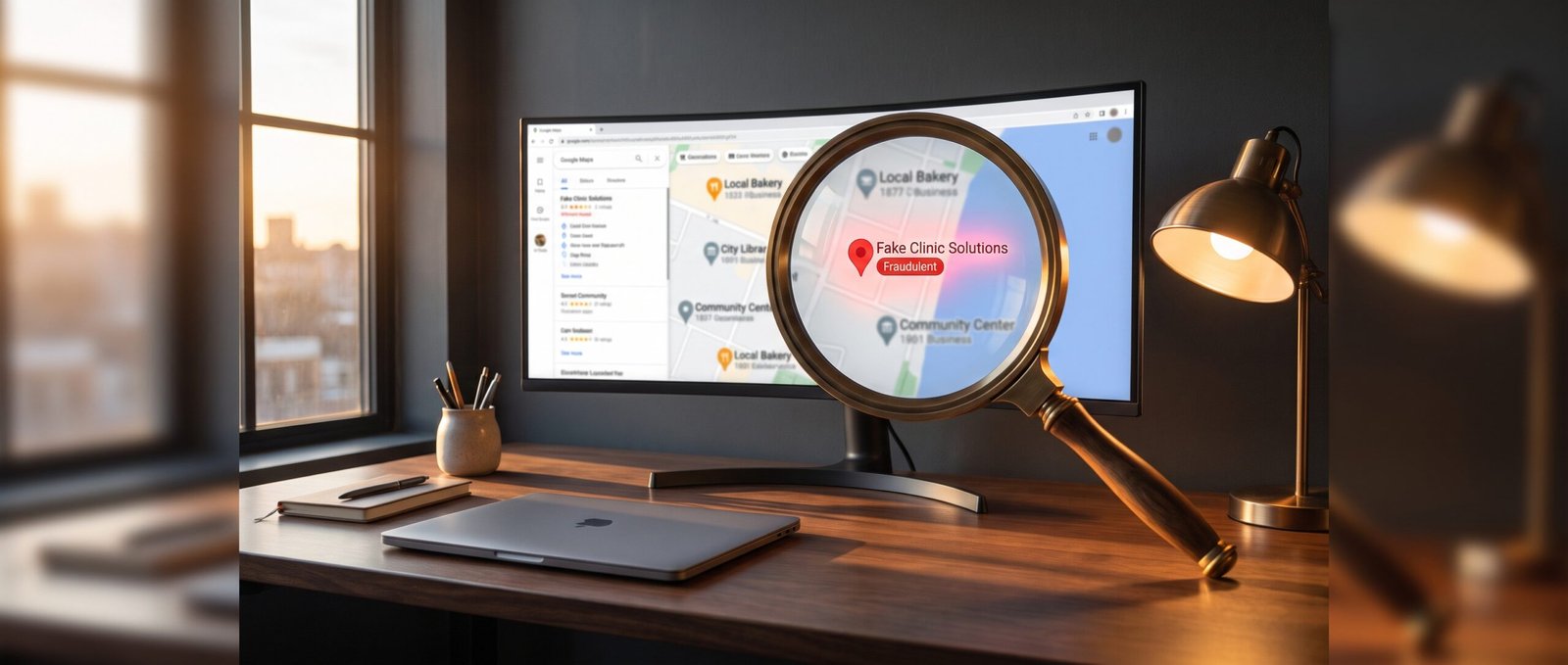
Google’s 2025 Maps trust-and-safety report says it blocked or removed 292 million policy-violating reviews and removed 13 million fake Business Profiles, yet spam listings still crowd map-pack results for plumbers, locksmiths, and clinics.
What this means for you
- Fake listings cluster in high-value trades: locksmiths, plumbers, HVAC, restoration.
- Reporting spam to Google has no published timeline and no guaranteed removal.
- Core Web Vitals and HTTPS are ranking signals, but Google says content matters more.
- A slow, thin website wastes the clicks your real listing already earns.
- Beating spam means fixing your Google profile and your website together.
Why fake listings outrank real businesses
Google requires verification before anyone can manage a Business Profile, but verification confirms access, not legitimacy.
Locksmiths, HVAC crews, and garage-door repair carry the highest value per lead, which is exactly why spammers target them first. A site built to convert is cheap insurance once your listing breaks through, long before you win the spam fight entirely.
Spammers rent a virtual office, a mailbox store, or an empty unit inside the exact service area they want to dominate. They then name the listing something like ’24/7 Emergency Plumber Downtown’ to front-load keywords into the one field Google weighs heavily.
Local ranking runs on three inputs: relevance to the search term, distance from the searcher, and prominence built from reviews and citations. A fake address two blocks closer can out-rank a licensed shop three miles out, because distance is measured from a pin, not inspected in person.
Google cannot send an inspector to each of the roughly 250 million places it says Maps covers, so it leans on automated signals that spammers have learned to mimic. That gap is the entire business model.
Google’s dilemma is real: tighten verification and legitimate home-based businesses get locked out; loosen it and spam floods back in.
That trade-off is why spam enforcement lags behind spam creation, and why your own listing’s trust signals still matter more than any single Google update.
The scale of Maps spam in 2025
Fake listings would not matter much if searchers ignored online signals, but they do not.
Nearly all consumers — 97 percent in BrightLocal’s 2026 Local Consumer Review Survey of about 1,000 US adults — say they read reviews before choosing a local business.
A fake listing with inflated reviews sitting above a real shop captures the first click, and often the only one, because the map pack sits above the organic results.
Google’s April 2026 Maps trust-and-safety update reported blocking or removing more than 292 million policy-violating reviews and 13 million fake profiles in 2025, up from 240 million reviews and 12 million profiles in 2024.
Older totals from 2021 through 2024 still circulate and should not be read as current.
Review removals rose about 21 percent year over year, while fake-profile removals rose about 8 percent — enforcement improves, but spam creation has not slowed.
Where the spam effort concentrates
Here is where that spam effort concentrates, by tactic.
| Tactic | Why it works |
|---|---|
| Virtual office address | Mimics local presence without real overhead |
| Keyword-stuffed business name | Boosts relevance signal for category searches |
| Lead-gen call center | Routes calls nationally while appearing hyper-local |
| Duplicate or bulk listings | Floods the map pack with the same company |
| Review gating or incentives | Inflates star rating ahead of real competitors |
Reporting spam through official channels
Sterling Sky’s guide documents two practical paths for reporting a suspicious listing, and neither one is instant.
The first is Maps’ own ‘Suggest an edit’ flow for places that are closed, fake, or misleading. Sterling Sky warns that simple edits are often denied or reversed, and says Google has retired the forum’s volunteer spam-report section.
The second is Google’s Business Redressal Complaint Form, built for misleading names, addresses, phone numbers, or URLs. It asks for evidence: a business license, a lease, or a Street View screenshot of the actual address.
Neither path publishes a timeline. Google cannot guarantee action and will not disclose the outcome of a specific case, so practitioners report waits running into weeks.
That caution is partly defensive: a public takedown queue would hand spammers a map of exactly what triggers removal.
- Screenshot the listing, its reviews, and its photos first; spammers often edit once flagged.
- Check the address on Street View to confirm it isn’t a mailbox store or empty lot.
- File through the redressal form with documented evidence and keep the case ID Google emails.
- Batch duplicate listings together so related spam is reviewed as one pattern.
- Log every filing date so you can escalate if nothing changes after a few weeks.
“Google reported blocking or removing 292 million policy-violating reviews in 2025 — and the fakes that slip through still compete for clicks with licensed, local businesses.”
Core Web Vitals and the trust gap
Winning the spam fight does not fill your calendar; your website does.
Google’s Core Web Vitals set the technical bar: largest contentful paint under 2.5 seconds, interaction to next paint under 200 milliseconds, and layout shift below 0.1, each measured at the 75th percentile of real visits.
Those thresholds have not moved since interaction to next paint replaced first input delay in March 2024.
An outdated template, a missing HTTPS padlock, or a contact form that fails silently reads as one more fake listing, not a licensed local business.
HTTPS has been a lightweight ranking signal since 2014, and it has become table stakes for anyone deciding whether to hand over a phone number or a card.
Speed is a floor, not a strategy
Chasing a perfect Vitals score can backfire if it means stripping out the review widgets and booking tools local customers actually use; speed is a floor, not the whole house.
A site scoring well on Vitals but missing a phone number above the fold still loses the job to the business that made calling obvious.
Think of Core Web Vitals as a hurdle, not a strategy; clearing it only earns you the chance to be judged on everything else.
That is the real reason a slow site is expensive: it is not the ranking penalty, it is the visitor who closes the tab before the page finishes loading.
Pairing profile defense with site performance
Spam-proofing a local presence is a pairing, not a single fix.
On the profile side, consistency does the work: matching name, address, and phone across every directory, regular photo and post updates, and prompt responses to new reviews all signal an active, legitimate business.
On the website side, a mobile-first layout, a working contact form, and real legal pages do the same job for a human visitor deciding whether to trust you enough to call.
Neither side substitutes for the other. A pristine profile pointing at a broken site just moves the drop-off from the search results page to the landing page.
In our own client work, not independently audited, businesses that pair a fast, professionally hosted site with active profile management convert more of the clicks they already win.
The businesses losing the most to spam are rarely the ones with the worst service; they are the ones whose online presence gives a searcher no reason to pick them over the listing one slot up.
Fixing that is less about chasing Google’s next policy update and more about making your own listing and your own site the obviously credible choice.
That is the real difference between winning the spam fight and winning the customer: one happens in Google’s index, the other happens on your own page.
None of this replaces good service; it just stops good service from losing to a worse competitor with a better-looking search result.
Spam defense gets you seen. ProXSites builds fast, credible websites that turn that visibility into booked jobs.
Sources
- The Ultimate Guide to Fighting Spam on Google Maps, Sterling Sky
- Google Maps uses AI to fight fake Business Profiles, Google (2024 figures)
- Google Maps 2025 Trust & Safety figures, announced April 16, 2026 — retrieved via Search Engine Roundtable, not from Google’s post
- Local Consumer Review Survey 2026, BrightLocal (97 percent, per BrightLocal)
- Core Web Vitals, Google Search Central
- HTTPS as a Ranking Signal, Google Search Central, 2014
- Business Redressal Complaint Form, Google
Commercial disclosure: ProXSites sells website design and hosting, and the proxsites.com links above point to our own paid services. This is editorial content, not independent research. We have no affiliation with, and were not compensated by, Google, Sterling Sky, or BrightLocal.
The 2025 figures are Google’s own totals from its April 2026 Maps trust-and-safety announcement, retrieved via industry press rather than from Google’s post; the 2024 comparison is from Google’s blog.