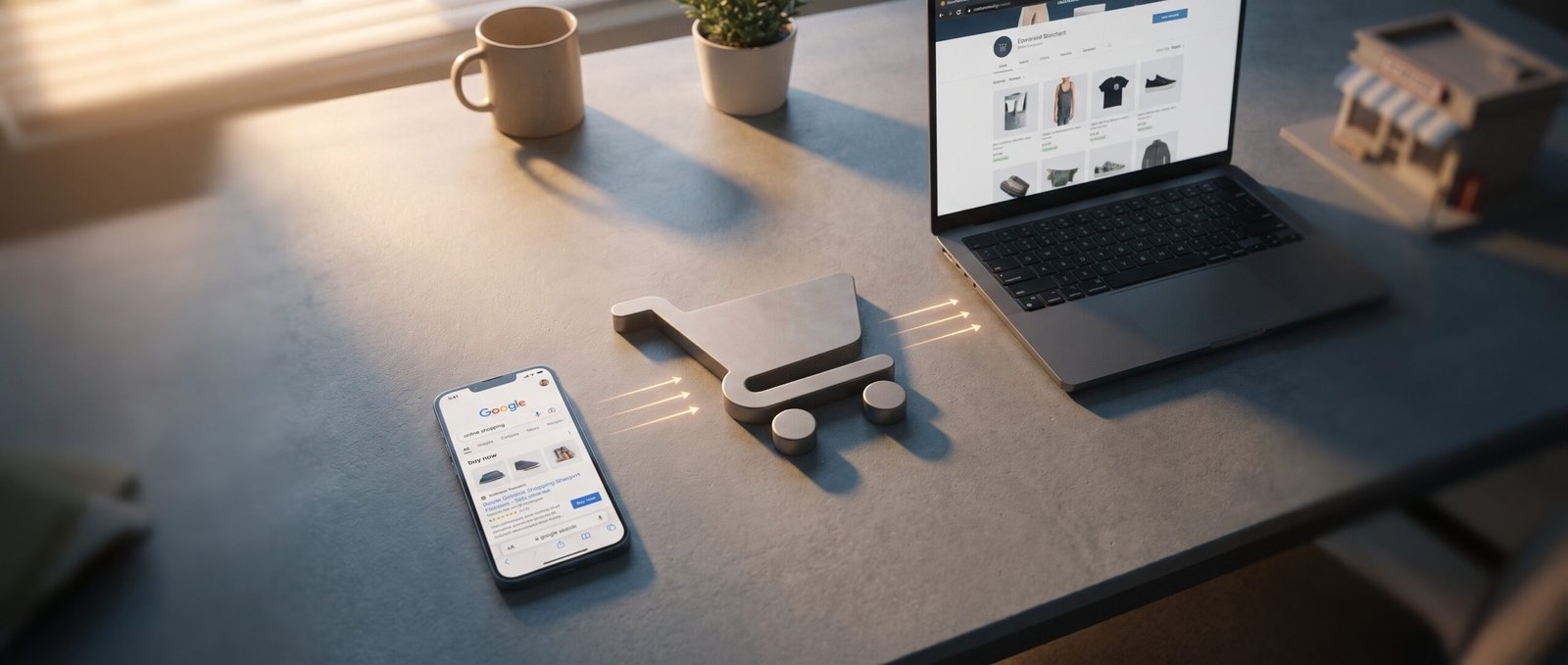

Only 5% of local shoppers buy straight out of an AI chat, per a Yext survey of nearly 4,000 consumers summarized in Whitespark’s Q3 2026 roundup — the rest still check other sources, including your website, before they spend.
What this means for you
- Keyword-led business names correlate with 2-5x more top-3 local pack placements, per Whitespark’s 1.4M-profile study.
- A fully complete GBP tracks with ~19 spots better average rank and triple the top-10 rate.
- 95% of shoppers don’t buy inside an AI chat, per Yext.
- Yelp licensed roughly 330M reviews to OpenAI in July 2026, making your listing an AI input.
- Glassdoor reviews mentioning AI fell from 81% positive in 2019 to 43%, per iPullRank.
Your business name is now a ranking input
Whitespark’s Q3 2026 roundup points to a study of more than 1.4 million Google Business Profiles across 17 industries that found a correlation between keywords in business titles and local pack rank.
If a thin homepage is all that backs up a strong profile, a rebuild from ProXSites gives each service its own page instead of a single line in a list.
Whitespark reports keyword-led titles earned 2x to 5x more top-3 placements; we could not independently verify its per-industry breakdown.
Keyword-stuffing a GBP title is still against Google’s guidelines, so this is not license to rename your business after a search term.
It is a reason to repeat your real name, service terms, and city consistently across title tags, headers, and LocalBusiness structured data.
None of that means changing the sign on your building, just making sure your digital presence uses the same descriptive language your customers already do.
Treat the correlation carefully: Localo, testing 131,000+ tracked keywords, measured title keywords moving the top-3 rate by only four percentage points.
Profile completeness is a website problem too
A separate Whitespark study of 1.8 million GBPs across 4,209 categories found that a specific primary category correlates with about 36% more appearances in the top 10 than a generic one.
Moving from 0 to 5 on Whitespark’s completeness index corresponded to about 19 positions of average rank, with the top-10 rate rising from 4% to 13%.
Well-chosen additional categories correlated with another 6 to 17 rank positions on top of that, compared with running on a single category alone.
Choosing the most niche-sounding category can backfire if it undersells your actual service range, so match the closest accurate option rather than the cleverest one.
Here is what that completeness gap looks like in Whitespark’s own numbers.
| Profile factor | Correlation with local pack rank |
|---|---|
| Generic primary category | Baseline ranking performance |
| Specific primary category | ~36% more top-10 appearances |
| Completeness score of 0 | Baseline rank and top-10 rate |
| Completeness score of 5 | ~19 positions higher, 4% to 13% top-10 |
| Specific plus additional categories | 6-17 positions higher than one category |
A complete, specific profile only pays off if the website behind it has a real page for that exact service, not one generic services tab.
If every category funnels into the same page, there is nothing specific for Google, or an AI system summarizing you, to point to.
Think of it as the difference between a GBP Google can confidently map to real inventory versus one it can only guess at.
Your website is the verification loop
Yext’s survey of nearly 4,000 local consumers, recapped in Whitespark’s roundup, found only 5% use AI chat as a direct path to purchase.
The rest move through what Yext calls a verification loop, checking search results, your website, your reviews, and whatever sources an AI cited before deciding.
Only 5% buy inside the chat. The rest keep checking — usually your own site — before they spend.
That loop collapses fast if the site a shopper finally lands on does not match what the AI or the profile promised.
Whitespark’s roundup recaps practitioner commentary arguing that real photos of real staff and inventory now beat generic stock shots for building trust.
It also reports that Google may be pulling identifiable entities out of images for AI answers, though no vendor documentation confirms the mechanism.
Google is also testing Local Services Ads inside AI Mode, and agentic tools can now place pickup orders through partner platforms without a site visit.
A website with working online booking or direct ordering gives both customers and the agents acting for them a path that doesn’t depend on someone answering fast enough.
None of this is theoretical for small operators: a restaurant that can’t confirm an agentic order in time risks eating the cost of food nobody picks up.
Reviews need a bigger stage than Google
Yelp licensed roughly 330 million reviews, ratings and business data to OpenAI in July 2026, so ChatGPT can answer local questions with Yelp content built in — though early spot checks found few visible Yelp citations.
If your Yelp profile has been neglected, it is effectively feeding an AI model that prospective customers may already be talking to.
Whitespark’s review-question study of 765 businesses found that only 25% of GBP categories trigger Google’s extra review-prompt questions at all.
Restaurants get the most, 14 questions, while most service businesses see just two: “Which services did you get?” and “How would you describe the price you paid?”
Across the whole dataset, Whitespark counted 40 distinct review questions, with the services question appearing 164 times and the pricing question 149 times.
Service pages that spell out a clear service list and at least a pricing range map directly onto those two questions Google already asks reviewers.
- Match your site’s service list to the “Which services did you get?” menu Google already surfaces to reviewers.
- Audit your Yelp listing for accuracy now that OpenAI licenses Yelp data.
- Keep your business name, address, and phone number identical across your site, GBP, and Yelp.
- Build one page per specific service category instead of a single generic services page.
- Replace stock or AI-generated photos with real images of your team and work.
Citations and AI exposure tracking still matter
Whitespark’s Q3 roundup points to renewed attention on both structured citations, like directory listings, and unstructured ones, like third-party mentions of your brand.
Both function as outside evidence that your business is real, which matters more as AI tools try to verify answers rather than just rank pages.
Google’s own structured data documentation still treats accurate, consistent markup as a baseline signal, not a ranking shortcut.
Google completed the worldwide rollout of Search Console’s generative AI performance report on August 31, 2026, giving a first-party view of AI Overview and AI Mode impressions.
SEO consultant Aleyda Solis, recapped by Whitespark, called it underwhelming alone: impressions and URLs only, with no clicks and no split between AI Overviews and AI Mode.
Even so, she recommends grouping the URLs that do get cited by template to see which pages are doing the work, then building more pages in that pattern.
That audit work is unglamorous, but it is also groundwork a competitor using the same AI tools as you cannot shortcut.
Stop publishing AI slop on your site
Glassdoor reviews that mentioned AI were 81% positive back in 2019.
By 2026 that figure had fallen to 43% positive, per iPullRank data cited in Whitespark’s roundup and not independently verified here.
Whitespark reports local audiences reacting the same way to obviously AI-generated marketing images.
A real photo of your storefront, staff, or dining room still reads as more trustworthy, and it may now carry more weight with AI systems summarizing your business too.
If your budget is tight, spend an afternoon with a phone camera instead of another AI image subscription.
The upside is real: businesses willing to invest in genuine photography and copy now stand out simply by not looking like everyone else’s AI feed.
Your profile can only carry you so far. ProXSites builds and hosts local business websites designed to turn that profile traffic into booked jobs.
Sources
- Whitespark, 22 Local SEO Developments From Q3 2026
- Search Engine Land, Whitespark’s 1.8 million GBP study (2026)
- Google Search Central, Introduction to structured data (2026)
- Google Search Console Help, Generative AI performance report (2026)
- Axios, Yelp–OpenAI licensing deal (July 23, 2026)
ProXSites publishes this blog and sells the website and hosting packages described here. We are not affiliated with Whitespark, Yext, Yelp, Google or iPullRank, and we were not paid by them. This post was drafted with AI assistance and fact-checked by our team.